



RESPONSE:
Boeing has reviewed your query and provides the following responses:
Q1. By the FCTM, section “Flare and touchdown”: “ Begin with a stabilized approach on speed , in trim and on glide path.” What is the concept of being “in trim”. Would you please offer more details?
问题一:根据《飞行机组训练手册》(FCTM)“拉平与接地”章节的要求:“稳定进近应以目标速度、配平良好且沿下滑道开始。”其中“配平良好”的概念具体指?
A1. An airplane is “in trim” or “trimmed” when it is in a steady state and no pilot force is needed on the flight controls. When properly trimmed in pitch, the airplane airspeed is stable even if the Pilot Flying removes hands from the control yoke. If the PF pulls the control yoke, airspeed decreases. If the PF pushes, airspeed increases. When the PF’s push or pull input is released, the airplane returns to its trimmed pitch attitude and airspeed unless thrust has been changed. If the PF changes thrust but does not push or pull, the airplane will climb or descend to maintain the trimmed airspeed. The “in trim” state is an equilibrium unless it is disturbed by pilot input or thrust change. Proper pitch trim technique is essential for good airspeed control.
回复:当飞机处于稳定状态,飞行操纵不需要飞行员的力量时,飞机就处于“在配平状态”或“配平好状态”。当俯仰配平合适时,即使操纵飞机的飞行员将手从驾驶杆上拿开,飞机的空速也是稳定的。如果PF拉杆,则空速降低。如果PF推杆,则空速增加。当 PF松手不再推杆或拉杆,飞机回到配平的俯仰姿态和空速,除非推力已经改变。如果PF改变推力,但不推杆或拉杆,飞机将爬升或下降,以保持配平空速。“在配平状态”是一种平衡状态,除非受到飞行员输入或推力变化的干扰。适当的俯仰配平技巧对于良好的空速控制至关重要。
Q2. And from an aerodynamic standpoint, why does trimming in the flare increase hazards?
问题二:从空气动力学的角度来看,为什么在拉平阶段进行配平会增加风险?
A2. Trimming in the flare can change the elevator push-pull forces that the pilot feels while the trim is running. This can cause overcontrol of the elevator, resulting in unintended pitch up or pitch down as the airplane attempts to maintain a new trim speed. Thrust changes can make the situation worse. In all cases, a mis-trim increases the possibility that a balloon, a bounce, an adverse pitch attitude, and a rapid loss of airspeed can occur. A tail strike can result.
回复: 在拉平过程中配平会改变飞行员感受到的升降舵推拉杆力。这可能会导致升降舵控制过度,从而导致飞机在试图保持新的配平速度时出现意想不到的机头向上或向下。推力的变化会使情况变得更糟。在所有情况下,不当的配平都会增加弹跳、 不利的俯仰姿态和空速快速减小的可能性。这些可能导致擦机尾。
The airplane should be properly trimmed during approach. This will set a trim airspeed of VREF+5 (with wind additive if necessary). Proper trimming helps to establish the correct final approach speed and a stable approach. During a normal flare, the PF makes an appropriate and predictable pull input for a safe touchdown attitude. The predictable pull force for flare and touchdown promotes good control of touchdown airspeed and pitch attitude, and helps prevent tail strikes.
在进近时应正确配平飞机。这将设置一个配平空速为 VREF+5(必要时加风增量)。正确配平有助于建立正确的五边进近速度和稳定的进近。在正常的拉平期间,PF为安全的接地姿态进行适当和可预测的拉杆。拉平和接地时可预测的拉杆力可以促进对接地空速和俯仰姿态的良好控制,并有助于防止擦机尾。
If in trim during approach but a go-around is needed, the airplane is already trimmed for VERF+5 (plus wind additive). This is a safe airspeed to initiate the go-around maneuver and it helps to prevent excessively high pitch attitude, which can cause a tail strike. It may be helpful to remember that trimming sets the airspeed that the airplane attempts to maintain. Increasing pitch trim during the flare to avoid manual inputs on the flight controls means that the airplane will try to maintain a speed below the approach target speed. This could have unexpected results if thrust is increased for any reason, such as a go-around or a bounce recovery.
如果在进近过程中保持配平,但需要复飞,飞机已经为 VERF+5(加风增量)配平。
这是开始复飞机动的安全空速,它有助于防止过高的俯仰姿态,高俯仰姿态有可能导致擦机尾。关键是要记住,配平就是设定飞机想要保持的速度。在拉平期间增加俯仰配平以避免手动进行飞行操纵控制意味着飞机将试图保持低于进近目标速度的速度。如果出于任何原因(如复飞或弹跳改出)增加推力,这可能会产生意想不到的结果。
If attachments are referred to and are not present, please access them by logging into the Boeing Communication System on MyBoeingFleet or contact your Boeing Field Service Representative.
Sarah Parsley, Flight Operations Support
Ryan Vas, Manager
Customer Support
The Boeing Company
BCA Operations Centers 24 Hour Contact Numbers
787: +1 (206) 544-7787
All Other Models: +1 (206) 544-7500
在现代喷气式运输机的飞行运行中,波音飞行机组训练手册(FCTM)将“In Trim”(配平状态)列为稳定进近的三大基石之一。然而,在实际飞行训练,尤其是针对初级副驾驶(Cadet)的教学中,配平往往被简化为“减轻杆力”的手段,而忽略了其作为“飞行状态核心参照系”的深层气动意义。
在飞行员的早期训练中,配平通常被描述为一种“舒适性工具”——用来消除驾驶盘上的持续压力。这种描述虽然直观,但却掩盖了配平在飞行力学中的核心地位。在波音737等由于发动机推力线与阻力线存在耦合的大型飞机上,配平状态直接决定了飞机的动态响应特性。
FCTM 明确指出:“Begin with a stabilized approach on speed, in trim and on glide path.” 这句话不仅是操作规范,更是气动铁律。所谓的“In Trim”,并非指飞行员此刻“握紧、抓住了”飞机,而是指飞机在气动上达到了力矩平衡,即便没有飞行员的干预,飞机也会倾向于维持当前的能量状态。对于缺乏经验的副驾驶而言,理解“In Trim”是理解能量管理的第一步。未能建立正确的配平意识,是导致进近不稳定、拉平操作变形以及复飞姿态不可控的根源。
飞机在纵向上的平衡取决于重力中心(CG)与气动中心(AC)之间的力矩关系。对于波音737这类传统布局飞机,水平安定面(Stabilizer)的主要作用是产生负升力(Downward Lift),以平衡机翼产生的低头力矩。
当飞机处于“In Trim”状态时,满足以下力矩平衡条件:
其中,关键变量在于由升降舵(Elevator)和水平安定面共同决定的尾部力矩 M_{tail}。波音737采用了全动水平安定面(Trimmable Horizontal Stabilizer),这意味着配平不仅仅是移动调整片(Tab),而是改变了整个尾翼的安装角。
航空界有一句名言:“Trim for Airspeed”(为速度而配平)。这是“In Trim”概念的核心。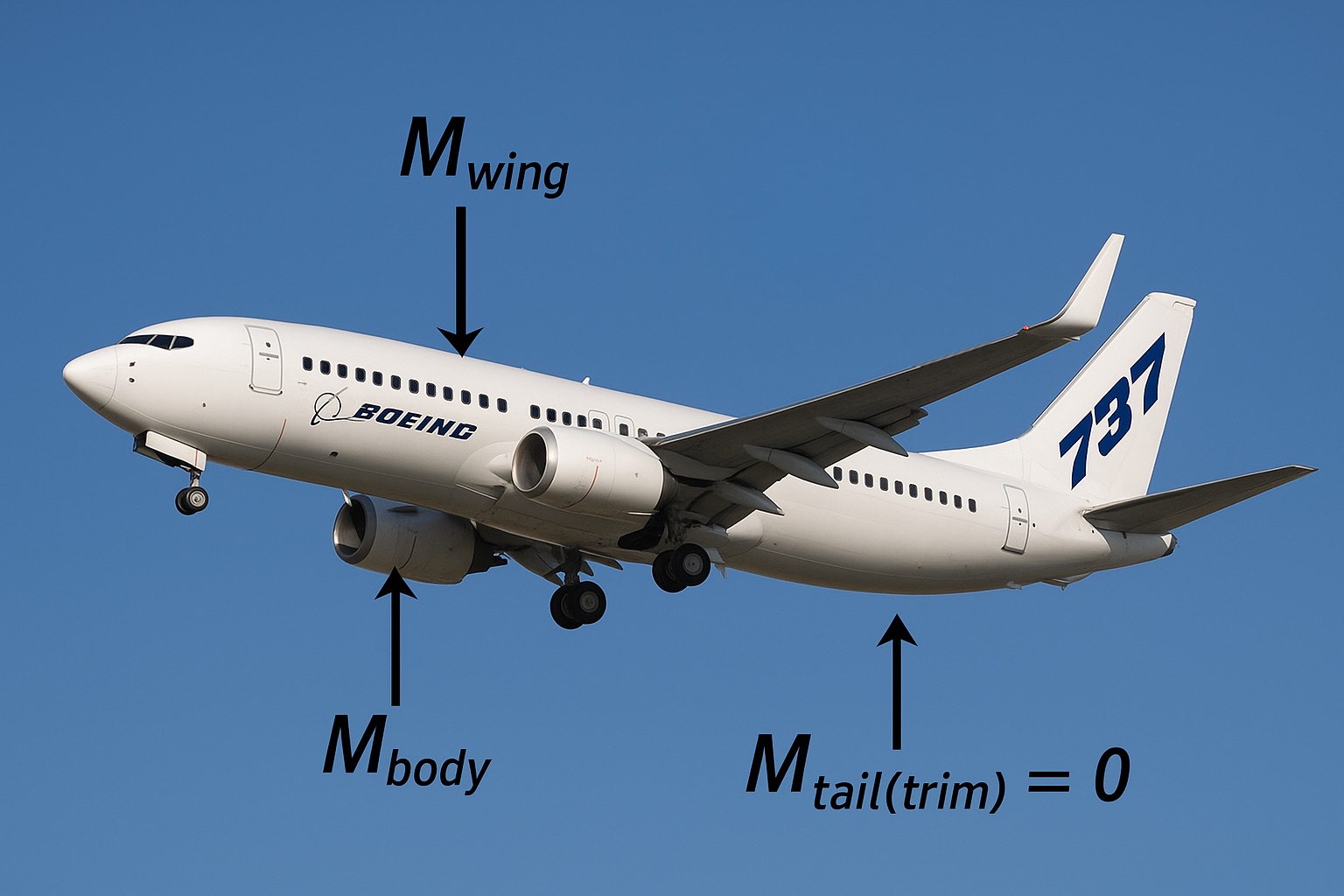
从气动角度看,每一位置的配平设定,都对应一个特定的平衡迎角。在给定的飞机重量和构型下,根据升力公式:
特定的迎角 alpha_{trim} 对应特定的升力系数 C_L,进而直接锁定了一个特定的平衡速度 V_{trim}。
因此,“In Trim”的物理定义是:飞机的安定面位置使得当前速度下的气动力矩为零。
- 如果实际速度 V < V_{trim}:由于动压不足,尾翼负升力减小,机头自然下沉,飞机寻求加速以恢复 V_{trim}。
- 如果实际速度 V > V_{trim}:动压增加,尾翼负升力增大,机头自然上扬,飞机寻求减速以恢复 V_{trim}。
这种自动回归设定速度的特性,即为速度稳定性(Speed Stability)。如果飞行员处于“缺少配平”状态(例如靠手臂力量拉杆维持 V_{ref}),实际上是强迫飞机飞在一个它气动上不平衡的速度。此时,飞机的自然趋势是低头加速,飞行员是在与飞机的自然稳定性“搏斗”。
如果在进近中,飞行员一直维持着 10 磅的拉杆力(欠配平),那么当气流扰动或拉平操作需要额外的 2 磅力时,他很难感知到这微小的变化(2磅淹没在10磅的背景力中)。
相反,如果飞机是完全配平的,任何微小的气流变化或姿态改变产生的力反馈都会被敏锐地捕捉到。
结论显而易见: 配平越好,飞行员的手感越敏锐。未配平的飞机让飞行员的手臂变得“麻木”,丧失了通过杆力感知能量变化的能力。
评论 (0)